
The Air You're Not Thinking About: Why Indoor CO2 Levels Deserve Your Attention


Walk into any modern office around 3 PM and you'll notice it: the room feels stuffy, colleagues are stifling yawns, focus is slipping, and someone inevitably jokes about needing another coffee. Most people blame the time of day, a heavy lunch, or simple fatigue.
More often than not, the real culprit is invisible, odorless, and quietly accumulating over your head: carbon dioxide (CO2).
As building design has prioritized energy efficiency over the last few decades, spaces have become tighter and better sealed to reduce heating and cooling costs. The unintended consequence is that fresh air exchange has dropped significantly in many buildings — offices, classrooms, hospitals, conference rooms, even bedrooms. And because we spend an estimated 90% of our lives indoors, that trade-off matters far more than most people realize.
What Exactly Is Happening
Outdoor air contains roughly 400-420 ppm (parts per million) of CO2 — a level our bodies evolved to handle without any issue. Every time we exhale, we release CO2 into the space around us. In a well-ventilated room, that CO2 gets diluted and carried away. In a sealed, densely occupied space with poor air exchange, it simply builds up.
This is why a small meeting room full of people can go from comfortable to noticeably "heavy" within 30-40 minutes, or why a shared office can feel sluggish by mid-afternoon even with the air conditioning running — AC controls temperature, not CO2 concentration.
How Rising CO2 Actually Affects You
The effects of elevated indoor CO2 are not just a matter of "feeling a bit tired." Research over the past decade has established a fairly consistent pattern of impact as concentrations climb:
Around 800-1,000 ppm — considered the general ceiling for good indoor air quality — occupants may start to report a stuffy feeling, and building-science guidelines increasingly treat this as the point where additional ventilation should kick in.
Between 1,000 and 2,000 ppm — a range many closed offices, classrooms, and meeting rooms reach regularly — studies have linked this range to measurable drowsiness, reduced concentration, and a decline in decision-making performance. This is often the range where people start to feel "foggy" without knowing why.
Above 2,000-2,500 ppm — controlled chamber studies have found significant reductions across multiple cognitive domains, including initiative, information usage, and strategic thinking. In crowded, poorly ventilated classrooms, meeting rooms, or vehicles, levels can climb into this zone or even higher.
5,000 ppm — this is the recognized 8-hour occupational exposure limit (used by bodies such as OSHA and ACGIH). Sustained exposure at or beyond this point is associated with headaches, dizziness, increased heart rate, and broader physiological strain.
30,000 ppm and 40,000 ppm — represent short-term ceiling limits and the "immediately dangerous to life and health" (IDLH) threshold respectively. These are extreme, rarely encountered outside of industrial or confined-space scenarios, but they mark the outer edge of the same continuum.
It's worth being clear about one distinction: comfort and cognition guidelines (the 800-1,000 ppm range) are not the same as workplace safety limits (the 5,000 ppm range). The former is about performance, wellbeing, and air quality perception; the latter is about acute physiological danger. Most offices, homes, and classrooms should be managed against the comfort and cognition benchmarks, not the industrial safety ceiling — because the goal isn't just to avoid harm, it's to help people think clearly and feel well.
Why This Matters Beyond "Feeling Tired"
The day-to-day consequences of chronically elevated indoor CO2 show up in ways that are easy to misattribute:
Reduced productivity and slower decision-making in offices and meeting rooms, particularly during long meetings in small, densely occupied spaces
Impaired concentration and learning outcomes in classrooms, where students spend hours in the same enclosed room
Poorer sleep quality in bedrooms, especially those with closed doors and windows overnight, which can cascade into next-day fatigue and reduced alertness
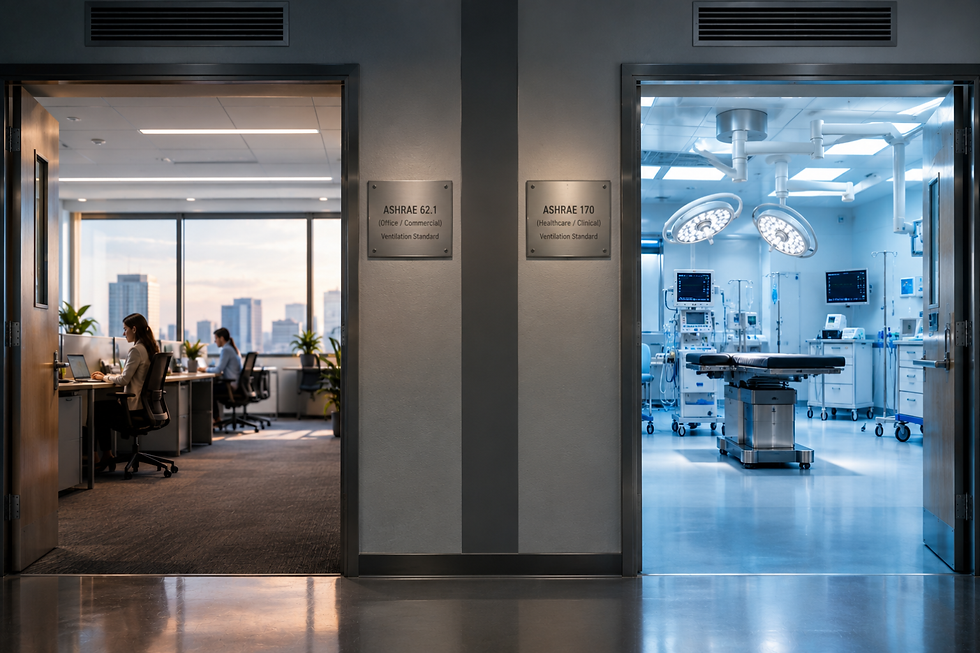
Elevated strain in clinical and critical-care environments, where healthcare staff are already operating under high cognitive load and dense occupancy is common
General symptoms such as headaches, restlessness, and difficulty focusing that are frequently blamed on stress or workload, when air quality is a contributing factor
None of this requires dramatic, industrial-level exposure. The concentrations linked to measurable cognitive effects are levels many indoor spaces reach routinely, several times a week, without anyone noticing.
Why Monitoring Is the Missing Piece
Here's the core problem: CO2 is invisible and odorless. Unlike smoke or a visible spill, there is no natural warning sign. A room can be well past the point of affecting cognitive performance while looking, smelling, and feeling completely normal to someone who has been sitting in it for a while (our perception adapts, which makes it worse, not better).
This is precisely why monitoring matters — not as an occasional check, but as an ongoing part of how spaces are managed:
It converts an invisible risk into a visible, actionable number. Real-time CO2 monitoring tells facility managers, hospital administrators, and office managers exactly when a space needs more fresh air, rather than relying on guesswork or occupant complaints.
It supports evidence-based ventilation decisions. Instead of running HVAC systems on a fixed schedule, CO2 data allows ventilation to respond to actual occupancy and air quality in real time — improving both air quality and energy efficiency.
It protects performance in high-stakes environments. In hospitals, ICUs, and critical care settings — where staff already operate under significant cognitive load — maintaining low CO2 levels is not a comfort feature, it is a patient-safety consideration.
It builds a long-term record. Continuous monitoring builds a picture of when and where a building's ventilation is falling short, enabling targeted fixes instead of blanket, costly overhauls.
Practical Takeaways
You don't need to be an engineer to start improving the air around you:
If a meeting room consistently feels stuffy after 30-40 minutes, treat that as a signal, not an inconvenience — increase ventilation or reduce occupancy time.
In homes, cracking a window or door overnight, especially in bedrooms, can measurably improve morning alertness.
In offices, schools, and hospitals, real-time CO2 monitoring — rather than periodic manual checks — is the only reliable way to catch problems before they affect people.
Treat CO2 as a proxy for overall ventilation health: where CO2 accumulates, other indoor pollutants often accumulate too.
The Bigger Picture
Indoor air quality has historically taken a back seat to more visible facility concerns — lighting, temperature, aesthetics. But as the evidence around CO2's direct impact on cognition, wellbeing, and even long-term health continues to build, it's becoming clear that air quality deserves the same level of attention and infrastructure investment as any other critical building system.
The spaces where we work, learn, heal, and rest all deserve air that supports us rather than quietly working against us. Monitoring is the first, simplest step toward making that a standard — not an afterthought.
Life Scan Medical works with hospitals and institutions on infrastructure and infection control solutions that support healthier, safer indoor environments.


Comments